Cap Compression Molding Machine Price: How Much Does It Cost in 2026?
A factory floor humming at full tilt, a single machine rotating without pause, and thousands of perfectly formed bottle caps dropping out — clean, precise, identical — every single minute. That machine is a Cap Compression Molding Machine, and if you're reading this, you're probably considering buying one.
The first question almost every buyer asks is simple: what does Cap Compression Molding Machine Price?
Here's the honest answer — there is no single number. The investment in a Cap Compression Molding Machine depends on how many caps you need to produce, how fast, in what industry, and what kind of long-term support you expect from your supplier. Two buyers with different production needs should be quoted very different machines.
This guide walks you through every factor that shapes the investment — clearly, without jargon — so you can walk into any conversation with a manufacturer already knowing what questions to ask and what the answers should mean for your business.
What Is a Cap Compression Molding Machine — and Why Does It Matter?
Before the numbers, a quick story about the machine itself.
Traditional injection molding — the older method — forces molten plastic into a mold through channels called runners and sprues. When the cap pops out, there's leftover material from those channels. That material is waste. Not a lot per cap, but multiply that across 30,000 caps an hour, running 16 hours a day, 300 days a year — and it adds up fast.
A cap compression molding machine takes a completely different approach. It starts with raw plastic resin — usually HDPE or PP — heats it, and cuts it into precisely dosed pellets. Each pellet is exactly the amount of plastic needed for one cap. That dose is then placed directly into a mold cavity and compressed under heat and pressure into a finished cap.
No runners. No sprues. No excess. Zero material waste.
Cap Manufacturing Principle
The result is a process that is simultaneously faster, more consistent, and more material-efficient than injection molding — which is why beverage plants, pharmaceutical companies, cosmetic manufacturers, and food packaging units around the world have made the switch.
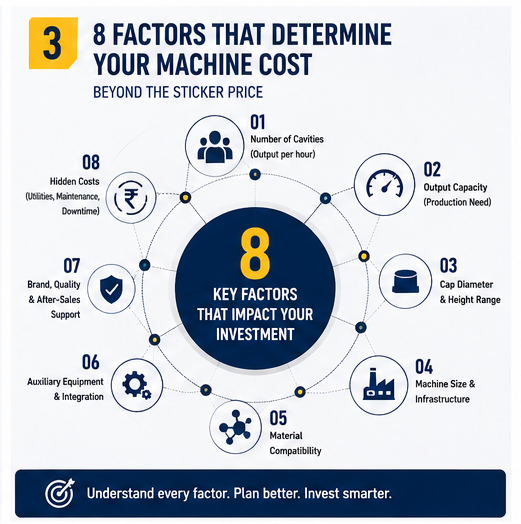
The Eight Factors That Determine Your Investment
Most buyers focus on the sticker price. Experienced buyers look behind it. Here are the eight things that actually shape what a Cap Compression Molding Machine Cost — and what it costs you to run.
01.Number of Cavities — The Single Biggest Variable
If there's one number that drives the price of any Cap Compression Molding Machine more than anything else, it's the cavity count. More cavities means more caps produced per rotation of the machine. More caps per rotation means more output per hour. More engineering, more precision, and yes — a higher investment.
Here's how the Jobo India model range breaks down by cavity and output:
| Model | Cavities | Production Capacity | Best For |
|---|---|---|---|
| JOBO 16CS | 16 Cavities | 12,000 – 18,000 caps/hr | New plants, small–medium scale |
| JOBO 24CS | 24 Cavities | 18,000 – 30,000 caps/hr | Growing manufacturers |
| JOBO 36CS | 36 Cavities | 24,000 – 43,000 caps/hr | Large beverage & pharma plants |
| JOBO 36CSS | 36 Cavities (High Speed) | 35,000 – 55,000 caps/hr | 24/7 high-volume operations |
The practical question isn't "how many cavities should I buy?" — it's "how many caps per hour do I actually need to produce?" Start there, and the right model becomes obvious.
02.Cap Diameter and Height Range — One Machine, Your Full Product Line
Across the entire Jobo India model range — from the entry-level 16CS to the high-speed 36CSS — every machine handles the same cap size range:
Cap Diameter: 18 mm to 60 mm
Cap Height: 12 mm to 50 mm
That range covers the full industrial spectrum. The small 18 mm pharmaceutical bottle closure. The standard 28 mm water bottle cap. The 38 mm juice and CSD closures. The wide 60 mm food packaging cap. All of them, on the same machine.
Why does this matter for your investment? Because it means you won't outgrow your machine when your product range expands. If you're producing water caps today and plan to add CSD caps or pharma closures next year, your Jobo machine already handles both — without a second purchase.
03.Machine Size and Infrastructure — Plan the Floor Before You Buy
One of the most commonly overlooked investment costs isn't in the machine itself — it's in preparing your facility to receive it. A cap compression molding machine is a serious piece of industrial equipment. It needs the right floor, the right ceiling clearance, and the right access for maintenance.
| Model | Footprint (L × W × H) | Machine Weight |
|---|---|---|
| JOBO 16CS | 3,700 × 1,620 × 2,100 mm | 5,000 kg |
| JOBO 24CS | 3,910 × 1,920 × 2,100 mm | 7,000 kg |
| JOBO 36CS | 4,550 × 2,200 × 2,100 mm | 9,000 kg |
| JOBO 36CSS | 4,600 × 2,200 × 2,100 mm | 10,000 kg |
A 10-tonne machine needs reinforced flooring. It needs proper lifting equipment during installation. It needs aisle space on all sides for technician access. These are real costs — civil work, electrical connections, cooling water supply — and they belong in your total investment planning, not as an afterthought once the machine has shipped.
If you're building a new Bottle cap Manufacturing Machine facility from scratch, design the floor plan around your chosen machine from day one. If you're adding a machine to an existing plant, verify your floor load rating and available footprint before committing to a model.
04.Material Compatibility — HDPE and PP, Both Handled Equally
All Jobo India machines run on the two most widely used plastics in cap manufacturing: HDPE and PP.
HDPE (High-Density Polyethylene):the standard for water caps, beverage closures, and general-purpose packaging. Strong, lightweight, food-safe, chemically resistant.
PP (Polypropylene): the preferred choice for pharmaceutical closures, cosmetic caps, and applications requiring better heat resistance or a degree of flexibility.
Both materials are supported equally across all four models. You can run HDPE water caps for a beverage client in the morning shift and switch to PP pharma closures for a pharmaceutical customer in the afternoon — same machine, no modifications required.
Need Help Choosing the Right Cap Compression Molding Machine?
Not sure whether a 16, 24, or 36 cavity machine is right for your production target? Talk to our experts and get a customized recommendation based on your output requirements.
Chat on WhatsApp05.Cap Types — What the Machine Can Produce
Water Caps: the standard screw closure used in packaged drinking water
Carbonated Soft Drink (CSD) Caps: carbonated soft drink closures requiring precise tamper-evident sealing
Juice Caps: fruit juice and nectar bottle closures
Pharma Caps: medicine bottle closures with tight dimensional tolerances
Cosmetic Caps: personal care and beauty product closures
The model choice isn't driven by cap type — it's driven by volume. A JOBO 16CS and a JOBO 36CSS can both produce a standard 28 mm water cap. The 36CSS just produces three times as many in the same hour. Your production requirement determines your model, not the product category.
06.Auxiliary Machines — Budget for the Full Production Line
Here's a detail many first-time buyers miss entirely: the compression molding machine produces the raw cap shape. A finished, market-ready, tamper-evident bottle cap goes through several more steps before it's ready to ship. Auxiliary machines handle those steps — and their cost is a real part of your total line investment.
Jobo India's full auxiliary lineup includes:
Cuts the tamper-evident security band around the bottom of each cap. Every cap requiring a tamper ring passes through here after molding.
Folds the anti-theft band to its final position. Synchronized with the compression machine to prevent line bottlenecks.
Brings ejected caps to the correct temperature before slitting. Ensures dimensions are fully set and the slit lands precisely.
Inserts an inner sealing disc for airtight or leak-proof closures. Non-negotiable for CSD caps and pharmaceutical closures.
Buying the full line from a single supplier — as Jobo India offers — simplifies everything. Installation is coordinated, the machines arrive pre-synced in speed, and all after-sales support comes from one team. Budget for the complete line from the beginning.
07.Brand Track Record and Certifications — The Hidden Cost of Buying Wrong
Two machines with identical spec sheets can deliver radically different outcomes in the real world. The difference lives in what happens after the machine is installed.
A machine from a manufacturer with no track record might look attractive on paper. But when a critical component fails at 2 AM during a production run — and it will, eventually, on any machine — the question isn't whether the part exists. The question is: how quickly can they get it to you? Does their technical team actually pick up the phone?
Jobo India has been manufacturing cap compression molding machines since 1988 — over 35 years of focused experience in this single specific segment. Machines running in production across 60+ countries. CE and TÜV SÜD certified. Operator training provided before handover. Technical support available after installation.
Evaluating any cap machine manufacturer, always ask.
What is the spare parts availability timeline for critical components?
Do you offer on-site technical support or only remote assistance?
What is the warranty period and what does it cover?
Do you provide operator training at our plant?
These answers carry as much weight as any specification in the brochure.
08.Hidden Costs — The Budget Items Buyers Often Forget
Even experienced procurement teams sometimes get caught off-guard by costs that didn't make it into the initial budget. Here's the complete checklist:
Mold sets:each cap size or type typically requires its own mold set; confirm exactly what's included with the machine
Installation and commissioning: confirm whether on-site commissioning is included or quoted separately
Operator training: clarify the scope: on-site at your plant vs. remote training
Shipping and import duties : if importing, these can add significantly to your total landed cost
Civil infrastructure : floor reinforcement, power connections, cooling water supply, compressed air lines
Auxiliary machines: slitting, folding, cooling, and lining equipment for a production-ready line.
Spare parts buffer : experienced manufacturers always stock critical spares from day one to avoid costly downtime.
Build all of these into your total investment picture before comparing machine prices. A machine that looks cheaper at the headline price can easily become more expensive when these are added in.
The Jobo India Model Range — At a Glance
Whether you're setting up your first Plastic Cap Manufacturing Machine or scaling a facility that already runs at high volume, there's a Jobo model built for your output target.
All models support cap diameters 18–60 mm and heights 12–50 mm. All produce Water, CSD, Juice, Pharma, and Cosmetic caps. Power supply: 380V, 50Hz (customizable).
Get a Customized Machine Quotation
Share your cap size, daily production target, and application. Our team will help you select the right machine and provide a detailed quotation.
Call Now: +91 84694 59013How to Choose the Right Model for Your Production Target
There's a simple, three-step framework that works for any buyer — no matter the scale.
Step 1: Calculate Your Required Caps Per Hour
Start with your daily target. Divide it by the number of operating hours in your shift schedule. That gives you the caps-per-hour figure that your machine must hit or exceed. Find the model that covers it.
Step 2: Think Three Years Ahead, Not Just TodayIf your orders are growing at 30–40% annually, it's often smarter to step up one model now than to run at full capacity within 18 months and face the disruption of adding a second machine. Factor in your growth trajectory, not just your current order book.
Step 3: Let Your Industry Guide Your Priorities
Pharmaceutical manufacturers often need tighter dimensional consistency — precise weights, exacting tamper ring placement, certifiable quality control. Beverage producers frequently prioritize raw output speed above everything else. Your industry shapes which model features deserve the most weight in your evaluation.
An Investment That Pays for Itself — Year After Year
The cost of a cap compression molding machine is a number you pay once. What it produces for you — every hour, every shift, every year — is the return on that investment. A machine that's correctly sized for your production, built by a manufacturer with a proven track record, supported by a responsive after-sales team, and complemented by the right auxiliary equipment will pay for itself faster than you expect.
Jobo India's range — from the JOBO 16CS to the JOBO 36CSS — covers every scale of cap compression machine production, from small regional plants to large international export facilities. All four models share the same engineering philosophy: high output, consistent quality, zero material waste, and reliability that doesn't require constant attention.
The right next step is straightforward. Share your daily production target — and your three-year plan — with the Jobo India team. They'll match you to the right machine and build a complete line proposal around it.
Frequently Asked Questions (FAQs)
1.What is a Cap Compression Molding Machine?
A machine that produces plastic bottle caps by compressing precisely dosed HDPE or PP pellets into mold cavities — with zero material waste, no runners, and no sprues.
2.How is Compression Molding different from Injection Molding?
Compression molding doses the exact plastic needed per cap — no waste. Injection molding leaves leftover runners and sprues every cycle, wasting material at scale.
3.What plastics does a Cap Compression Molding Machine use?
HDPE (for water, beverage, and food caps) and PP (for pharma, cosmetic, and heat-resistant caps). Both run on the same machine with no modifications needed.
4.What types of caps can it produce?
Water caps, CSD caps, juice caps, pharma caps, and cosmetic caps. The cap type doesn't determine your model — your required output per hour does.
5.How much does a Cap Compression Molding Machine cost?
No fixed price — it depends on cavity count, output target, auxiliary machines, and infrastructure. Always compare total line cost, not just the machine price.
6.How many caps per hour does each Jobo model produce?
JOBO 16CS: 12,000–18,000/hr | JOBO 24CS: 18,000–30,000/hr | JOBO 36CS: 24,000–43,000/hr | JOBO 36CSS: 35,000–55,000/hr
7.What auxiliary machines complete the production line?
Cap Cooler (sets dimensions), Cap Slitting Machine (tamper band), Cap Folding Machine (band forming), Cap Lining Machine (inner seal for CSD/pharma). All needed for market-ready caps.