Compression Molding Machines for Pharmaceutical Caps: Features & Benefits for Pharma Manufacturers
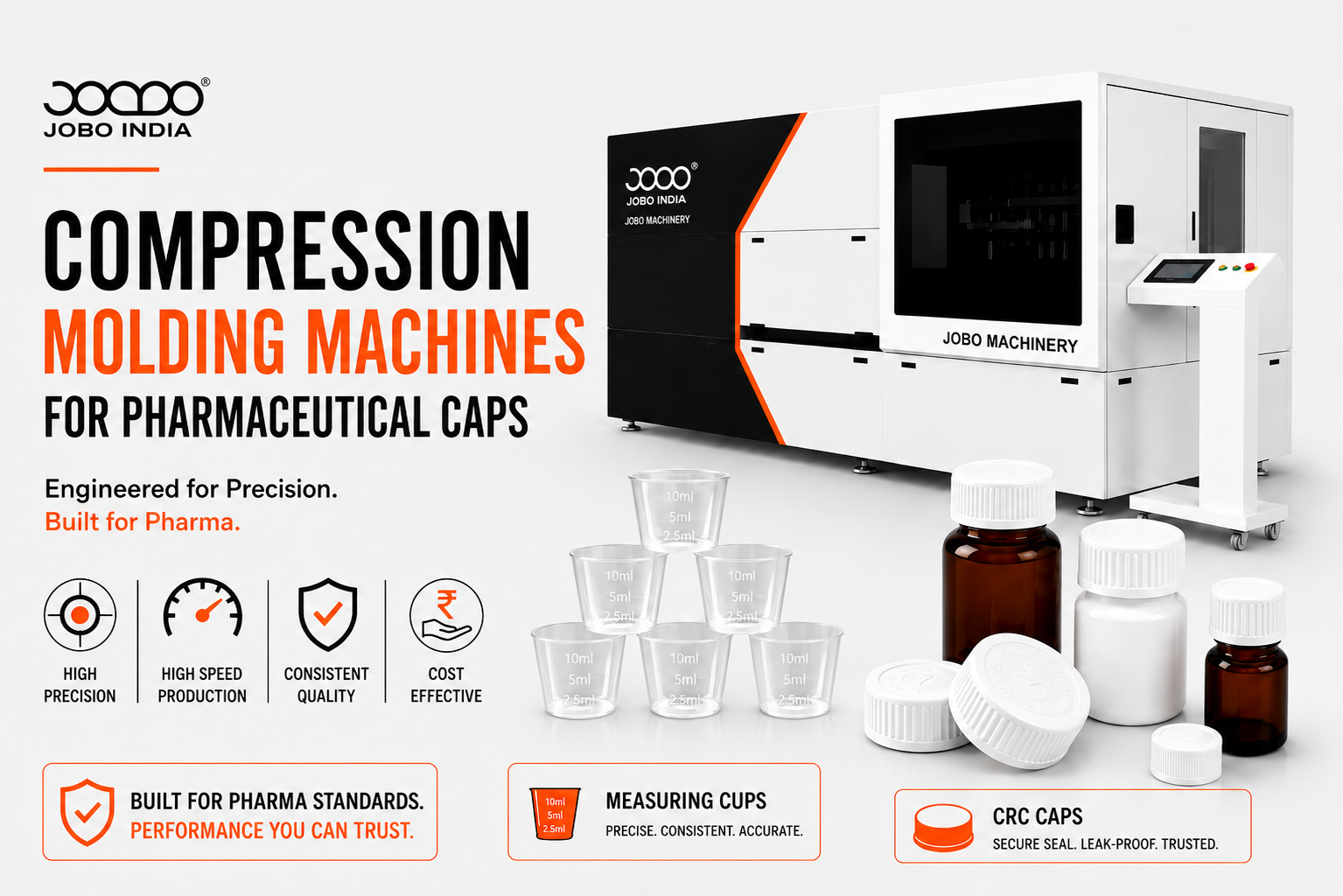
A pharmaceutical bottle's cap rarely gets a second thought from the person holding it — until it fails. A closure that doesn't seal properly, or a child-resistant mechanism that a toddler manages to open anyway, isn't a packaging inconvenience in this industry. It's a safety incident waiting to happen. That's the pressure pharma manufacturers carry every time they choose a cap supplier, and increasingly, every time they choose the machine that makes the cap in the first place.
A Compression Molding Machine for Pharmaceutical caps is increasingly becoming the go-to solution for manufacturing pharmaceutical caps, and has become the machine of choice for high-volume production. When used in the right applications, Compression Molding dispenses an exact amount of resin for each cap and shapes it under controlled pressure, cap after cap, cavity after cavity, with consistent production performance. Unlike conventional injection molding, this consistency is a quality benefit that matters just as much in pharma packaging as it does for drinks or cosmetics — particularly for uniform cap quality over large production runs.
Why Pharmaceutical Manufacturers Prefer Compression Molding Machines
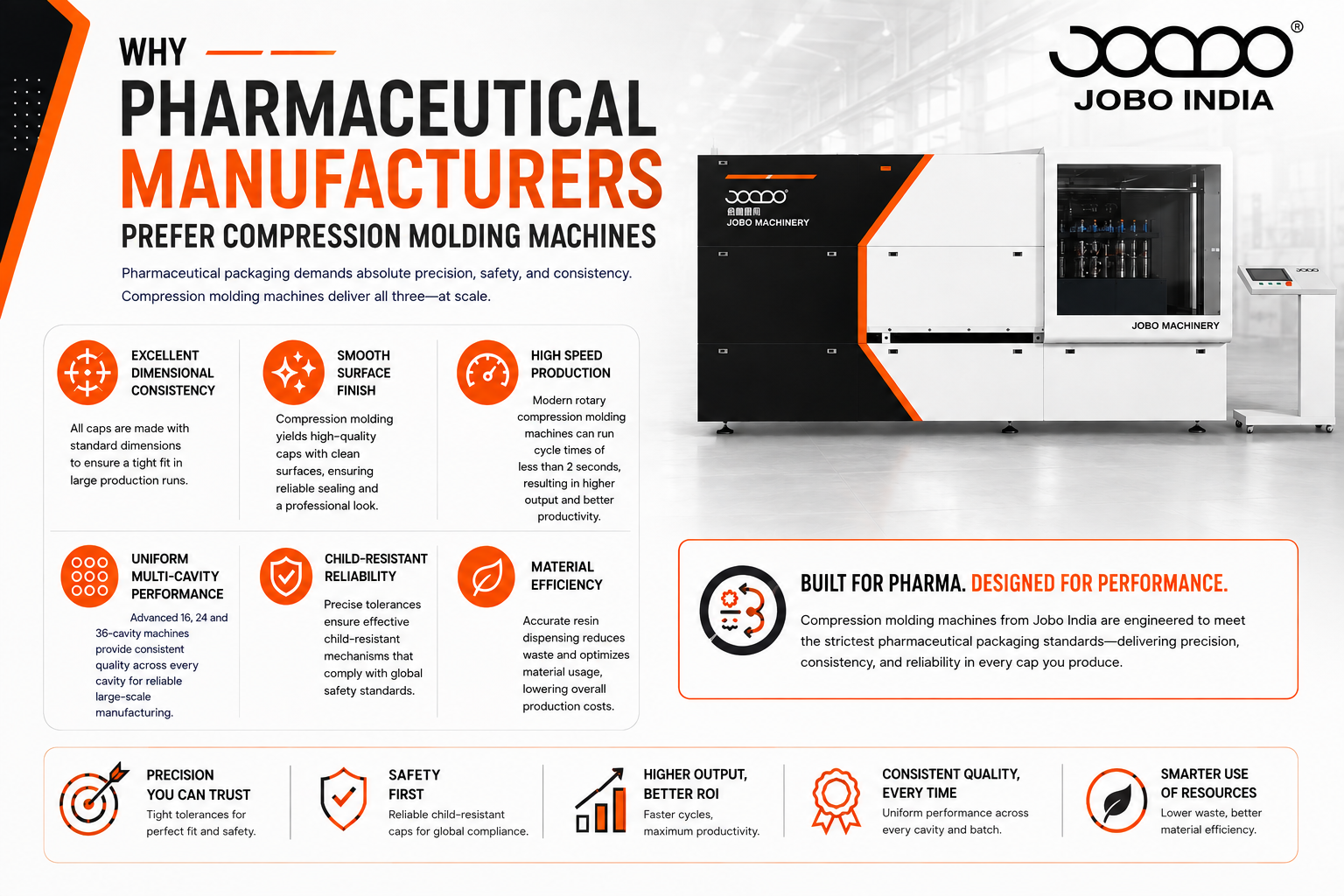
Pharmaceutical packaging standards are changing, and manufacturers are increasingly adopting Compression Molding technology to improve production efficiency, product consistency, and packaging quality. Modern Compression Molding machines are designed to offer the precision and reliability needed for high-volume production of pharmaceutical caps, and to help optimize material utilization and operational efficiency.
Excellent Dimensional Consistency
All caps are made with standard dimensions to ensure a tight fit in large production runs.
Smooth Surface Finish
Compression molding yields high-quality caps with clean surfaces, ensuring reliable sealing and a professional look.
High-Speed Production
With modern rotary Compression Molding Machines, you can run cycle times of less than two seconds, resulting in higher output and better productivity.
Uniform Multi-Cavity Performance
Advanced 16, 24, and 36-cavity machines provide consistent quality across every cavity for reliable large-scale manufacturing.
How Compression Molding Supports Child-Resistant Pharmaceutical Caps
Child-resistant closures (CRCs) are mandatory across most regulated markets for pharmaceutical and hazardous product packaging, and their entire function depends on manufacturing tolerance rather than material choice. The mechanism itself is simple in concept — push down, then turn. A locking ring inside the cap disengages only when both actions happen at once, a coordination sequence that young children typically can't manage but adults can perform without difficulty.
What makes that mechanism actually work in the field is dimensional accuracy at the mold. The locking ring, the internal thread pitch, and the skirt height all have to sit within a narrow tolerance band. A cap that's even slightly out of spec can either fail to lock — defeating the safety purpose entirely — or lock so tightly that legitimate adult users struggle to open it. Neither outcome is acceptable in a pharma packaging line.
This is where the Compression Molding process earns its place in CRC manufacturing specifically. Because each cap is formed from a precisely dosed resin pellet compressed under even hydraulic pressure, cavity-to-cavity variance stays low even at high cavity counts. A 24-cavity or 36-cavity Cap Compression Machine producing tens of thousands of caps an hour still needs cap 1 and cap 30,000 to behave identically on the bottle. That's a molding-process outcome — a Compression Molding Machine for pharmaceutical caps offers high production efficiency, low material waste, and consistent quality for suitable closure designs.
Compression Molding Machines for Pharmaceutical Measuring Cups
Liquid pharma formulations — cough syrups, pediatric suspensions, supplements — are almost always sold with a measuring cup, and the accuracy of that cup matters as much as the accuracy of the medicine inside the bottle. A cup molded with inconsistent graduation lines or inaccurate wall volume can lead directly to measuring errors, which is a far more serious failure than a cosmetically imperfect cap.
What's worth understanding here is that a compression molding machine for measuring cups and a machine for caps aren't two different pieces of capital equipment — on Jobo India's platform, they're the same rotary cap compression machine running a different mold. The resin dosing system, the hydraulic compression cycle, and the cooling stage all carry over; only the cavity mold changes to produce a graduated measuring cup instead of a threaded closure. For a pharma manufacturer, that means sourcing both the child-resistant cap and the measuring cup for the same product line from a single machine platform — one quality system, one set of process tolerances, and one supplier relationship instead of two.
The precision case is the same one that applies to CRCs: because each cup is formed from a precisely dosed resin pellet under even hydraulic pressure, the 5ml, 10ml, and 15ml graduation lines land where they're supposed to, cup after cup, without the wall-thickness drift that shows up in cheaper or inconsistently maintained tooling.
Key Machine Specifications for Pharma-Grade Cap Production
The technical range of a cap compression molding machine for pharmaceuticals determines what it can realistically produce for a pharma packaging line. Here's what to look for and why each spec matters:
| Specification | Range | Pharma Relevance |
|---|---|---|
| Cap Diameter | 18mm – 60mm | Covers standard pharma bottle neck sizes (18mm–33mm most common) |
| Cap Height | 12mm – 50mm | Accommodates CRC closures, which are typically taller than standard screw caps |
| Cap Material | HDPE, PP | PP is the preferred resin for pharma due to chemical resistance and heat tolerance |
| Cavity Configuration | 16 / 24 / 36 cavity | Higher cavity counts suit high-volume pharma bottling lines |
| Cycle Time | Under 2 seconds | Sub-2-second cycles reduce per-unit cost without sacrificing dimensional accuracy |
| Output | Up to 30,000 caps/hour | Matches high-speed pharma filling and capping lines |
| Compression System | Rotary hydraulic | Even pressure distribution reduces flash and dimensional variance across cavities |
Material Selection: Why PP Leads for Pharma Applications
Jobo India's Cap Compression Molding Machines for pharmaceuticals run both HDPE and PP resins, but pharma manufacturers overwhelmingly specify PP (polypropylene) for closures and measuring components, and the reasons are practical rather than arbitrary. PP tolerates higher sterilization and processing temperatures than HDPE without deforming, resists a broader range of chemical formulations, and holds its shape under the repeated stress of a CRC's push-and-turn mechanism over the life of the product. HDPE remains the workhorse for beverage and water caps, where cost efficiency and impact resistance matter more than chemical resistance — but for pharma, PP is the more defensible default.
How Compression Molding Machines Deliver Consistent Pharmaceutical Caps
It's worth being direct about something manufacturers sometimes blur in marketing copy: a cap compression molding machine does not itself make a cap "FDA compliant" or "CDSCO compliant." Regulatory compliance sits with the finished packaging component — its material grade, its design against applicable child-resistance and tamper-evident standards, and the manufacturer's own quality management system. What the machine controls is dimensional accuracy, repeatability, and material consistency — the manufacturing foundation that compliance is built on, but not compliance itself.
A pharma manufacturer buying cap-making equipment should expect precision and consistency from the machine, and expect to validate compliance separately through material certification, design testing, and their own regulatory process. Any supplier claiming otherwise is overstating what a piece of manufacturing equipment can guarantee.
Why Pharma Manufacturers Choose Jobo India
Jobo India has supplied Cap Compression Molding Machines since 1988, operating as the Indian partner of Jobo Machinery, which runs installations in more than 65+ countries. That history matters less as a marketing point and more as a practical one: pharma packaging lines run continuously, and a machine's long-term reliability — spare parts availability, technical support response time, and consistency across years of operation — is as important as its day-one specifications.
35+ years of Cap Compression Molding Machine experience, with machines running in 65+ countries.
Cavity configurations from 16, 24 to 36 cavity, covering low-volume pharma runs through high-speed production lines.
A single machine platform that produces both child-resistant caps and measuring cups through mold changes — one machine investment covering two critical pharma packaging components.
Full auxiliary equipment line — Cap Slitting, Cap Folding, Cap Cooler, and Cap Lining machines — to take a cap from molded blank to market-ready closure.
End-to-end support: Machine Installation, Technical Assistance, and Spare Support, rather than a single equipment sale.
Machines rated for HDPE and PP processing, covering both beverage-grade and pharma-grade resin requirements.
For a pharma manufacturer evaluating equipment suppliers, the combination of decades of continuous operation, a mold-flexible platform that covers both caps and measuring cups, and an auxiliary equipment ecosystem that finishes the cap rather than just molding it is what separates a genuine production partner from a machine vendor.
Need a Compression Molding Machine for Your Pharma Production Line?
Jobo India manufactures high-speed cap compression molding machines for pharmaceutical, water, CSD, and cosmetic caps — with 35+ years of experience and machines running in 65+ countries.
Chat on WhatsAppMold Changeover: What to Expect When Switching Between Caps and Measuring Cups
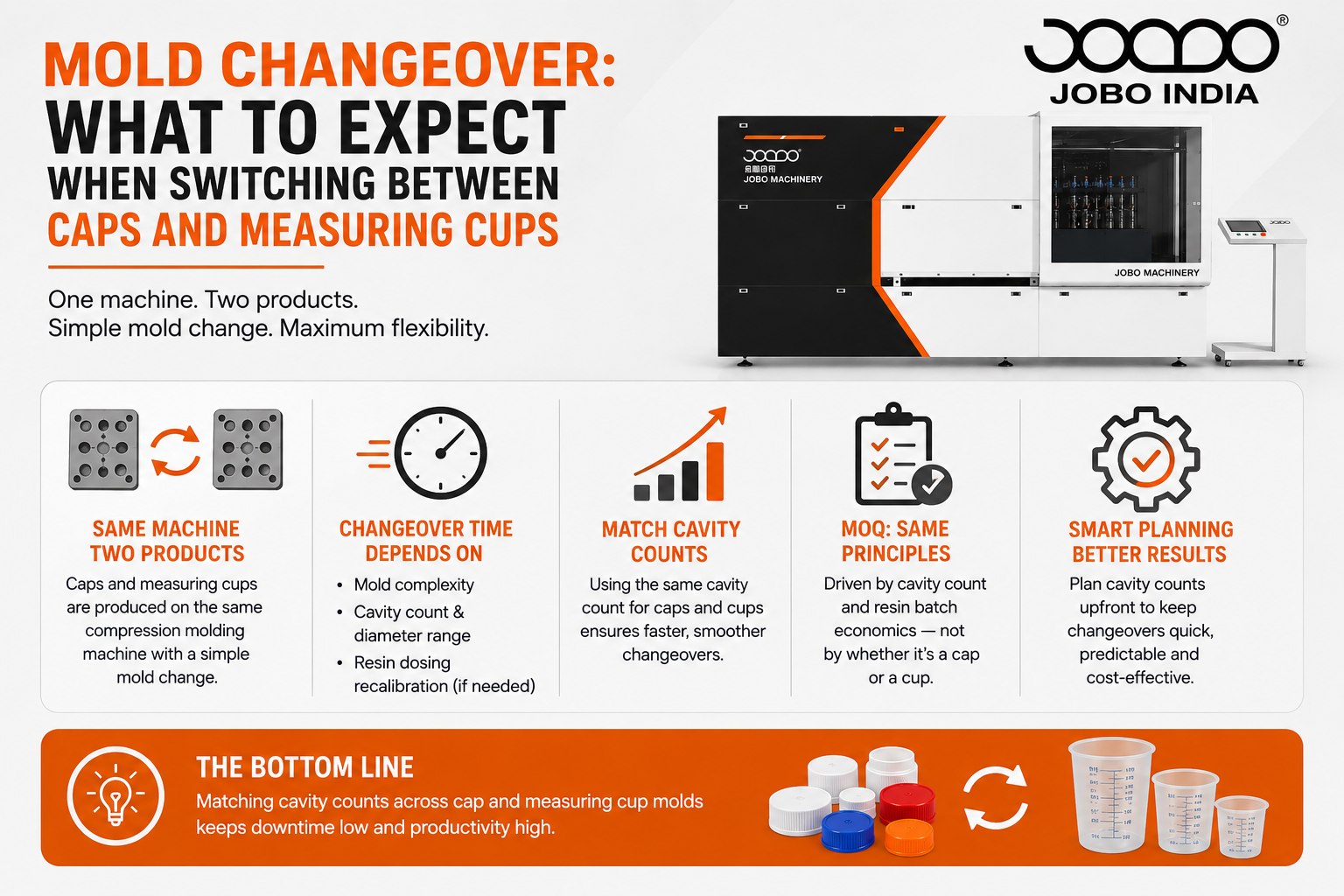
Once a pharma manufacturer understands that caps and measuring cups run on the same compression molding machine, the next question is almost always practical: how much does it cost in downtime to switch between them? The honest answer is that changeover time depends more on mold complexity than on the product itself. A straightforward swap between two closure molds of similar cavity count is a routine maintenance-window task — the kind of changeover a trained operator handles between shifts without materially affecting the day's output target.
What does add time is a change in cavity count or a change in cap diameter range, since either one typically means re-calibrating the resin dosing unit alongside the mold swap. A manufacturer running both a 24-cavity CRC mold and a 24-cavity measuring cup mold on the same machine will see a noticeably faster turnaround than one alternating between, say, a 16-cavity cap mold and a 36-Cavity Cup Mold. This is worth factoring into a production plan before ordering equipment, not after: if your line needs to alternate frequently between caps and cups, it's worth spacing both molds at matching cavity counts up front rather than treating cavity count as a decision made independently for each product.
Minimum order quantities work the same way on both sides — they're driven by the mold's cavity count and the resin batch economics, not by whether the finished part is a cap or a cup. A manufacturer already running a cap mold on a given cavity configuration typically finds that adding a measuring cup mold at the same configuration doesn't change their MOQ math meaningfully, since the underlying machine, resin handling, and cycle economics stay constant. The mold itself is the variable cost; the machine platform underneath it isn't.
For a manufacturer weighing whether to add measuring cups to an existing cap production line versus sourcing them from a separate supplier, this is usually the deciding factor: matching cavity counts across both molds keeps changeover fast and predictable, while mismatched configurations turn what should be a routine swap into a scheduling constraint.
Get a Customized Machine Quotation
Share your cap diameter, daily production target, and resin requirements. Our team will help you match the right compression molding configuration for your pharmaceutical application.
Call Now: +91 84694 59013Frequently Asked Questions (FAQs)
1. What makes compression molding better than injection molding for pharmaceutical caps?
Compression molding produces lower shrinkage, a smoother surface finish, minimal material waste, and higher consistency than injection molding — all of which matter more in pharma applications, where dimensional accuracy directly affects seal integrity and child-resistant mechanism function.
2. Can the same machine produce both child-resistant caps and measuring cups?
Yes. Jobo India's compression molding platform for pharmaceutical caps produces both through a mold change rather than a separate machine — the resin dosing system, hydraulic compression cycle, and cooling stage stay the same, and only the mold changes.
3. Does a compression molding machine guarantee regulatory compliance?
No. The machine delivers manufacturing precision and repeatability — compliance itself depends on material certification, closure design validation, and the manufacturer's quality management system. Treat machine specifications and regulatory compliance as related but separate requirements.
4. Which material is better for pharma caps — HDPE or PP?
PP (polypropylene) is generally preferred for pharmaceutical closures because of its higher heat tolerance, broader chemical resistance, and better long-term performance under repeated mechanical stress, such as a CRC's push-and-turn action. HDPE remains common for beverage and other industries.
5. What cavity configuration suits a mid-size pharma packaging line?
A 24-cavity machine is a common mid-volume choice, balancing output against capital cost. High-volume lines typically move to 36-cavity configurations for throughput, while smaller or specialty-run pharma lines may find a 16-Cavity cap Compression Molding Machine sufficient.
Jobo India's team can help match cap diameter, daily production target, and resin requirements to the right compression molding configuration for pharmaceutical applications. Share your production specifications for a detailed quotation.
Call: +91 84694 59013 | Email: info@joboindia.com