What Are Caps and Closures? Everything You Need to Know
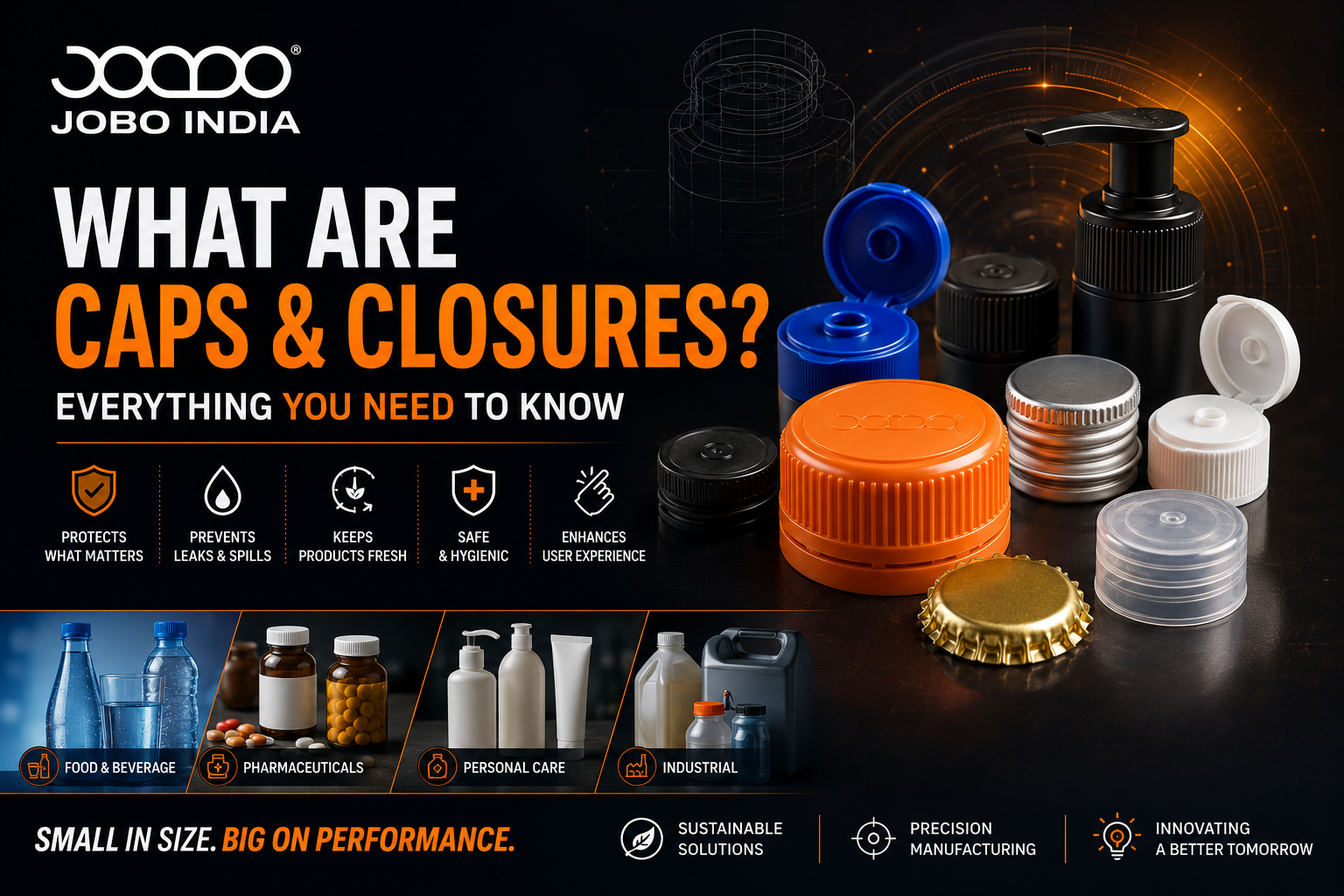
Every bottle, jar, tube, and container you pick up has one thing in common — a cap or closure that keeps what's inside safe, fresh, and secure. These small components are easy to overlook, but they play a critical role across nearly every industry on the planet. From the water bottle on your desk to the medicine in your cabinet, the right closure makes all the difference.
This guide covers everything you need to know about caps and closures — the types available, the materials they're made from, which industries depend on them, how tamper-evident and child-resistant mechanisms work, how caps are manufactured, and where the global closure industry stands today.
1. Types of Caps & Closures
Different closures serve different purposes. Choose the right one for safety, convenience and performance.
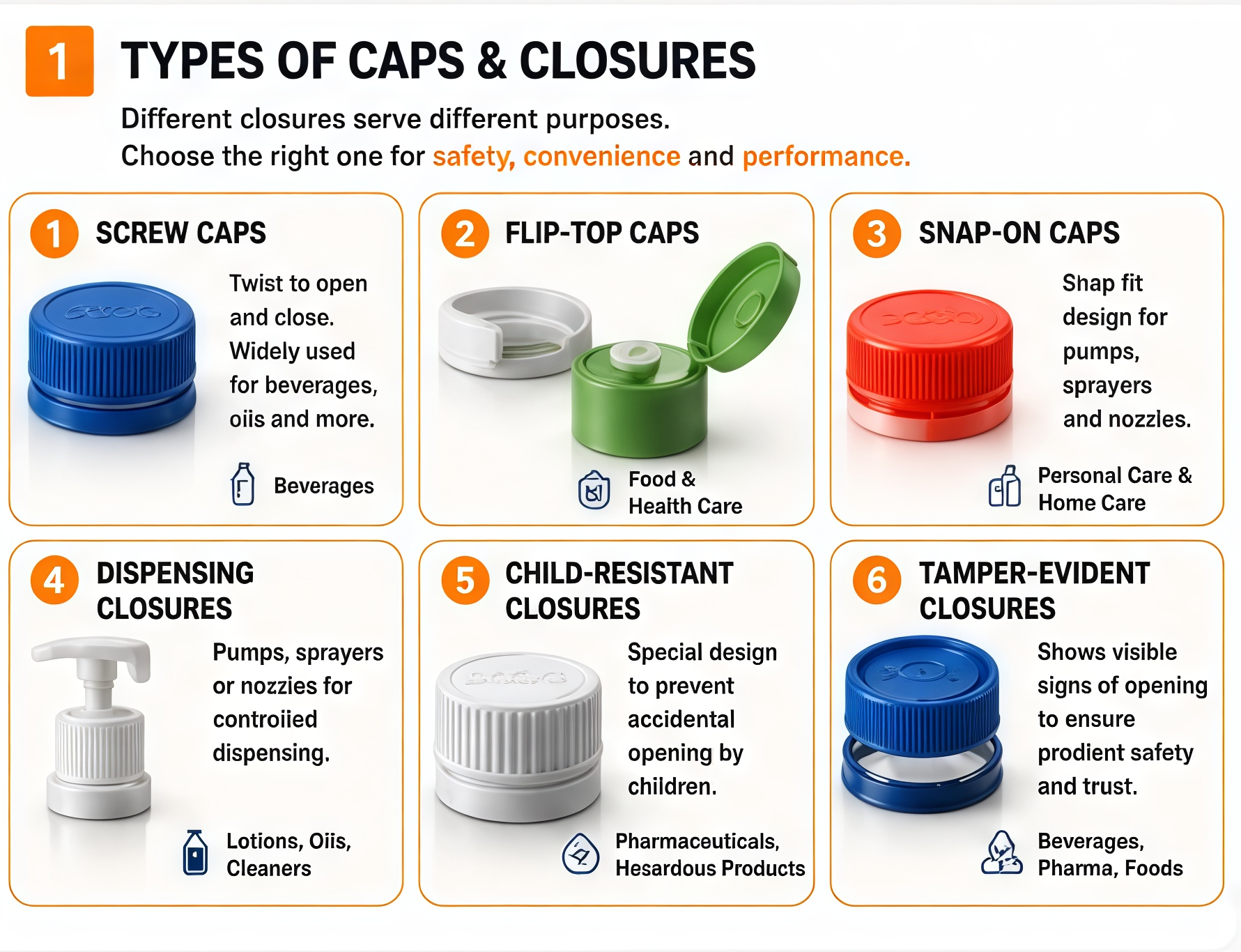
1. Screw Caps
Twist to open and close. Widely used for beverages, oils and more. The threaded design creates a reliable, repeatable seal that's simple for any consumer to use. Industry: Beverages.
2. Flip-Top Caps
A hinged cap that flips open with one thumb press and snaps shut for resealing. Ideal for controlled, one-handed dispensing wherever convenience matters. Industry: Food & Health Care.
3. Snap-On Caps
A snap-fit design for pumps, sprayers and nozzles. The cap locks onto the container neck without threading, allowing fast attachment with a secure hold during use and transport. Industry: Personal Care & Home Care.
4. Dispensing Closures
Pumps, sprayers or nozzles for controlled dispensing. Essential wherever precision flow matters — lotions, cleaning liquids, industrial fluids. Industry: Lotions, Oils, Cleaners.
5. Child-Resistant Closures
Special design to prevent accidental opening by children. Typically requires a two-step action — push down and turn simultaneously. A regulatory requirement for pharmaceuticals and hazardous products. Industry: Pharmaceuticals, Hazardous Products.
6. Tamper-Evident Closures
Shows visible signs of opening to ensure product safety and trust. The tamper band breaks on first opening and cannot be concealed or reversed. Industry: Beverages, Pharma, Foods.
2. Common Closure Materials
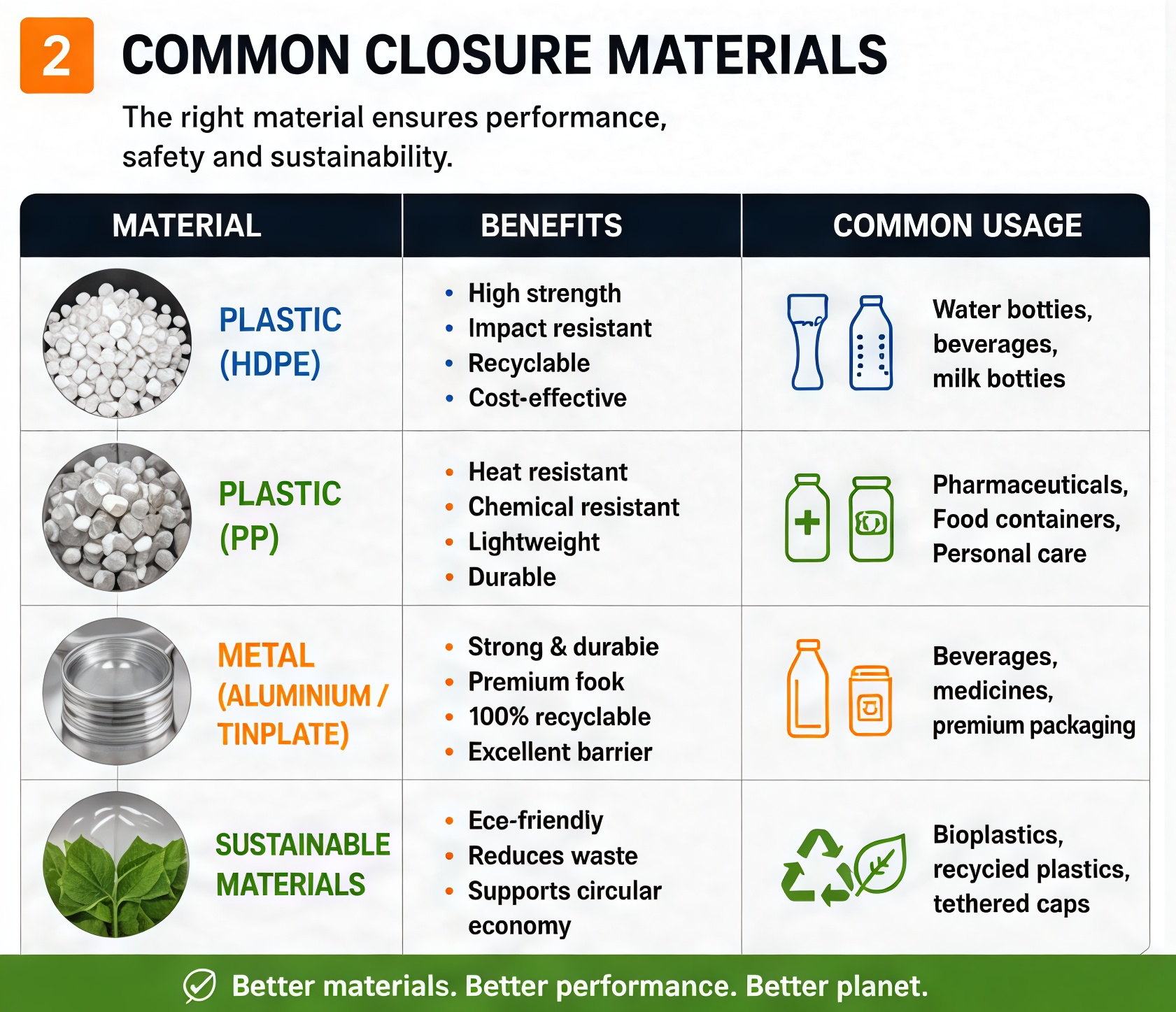
The right material ensures performance, safety and sustainability.
| Material | Benefits | Common Usage |
|---|---|---|
| Plastic (HDPE) | High strength · Impact resistant · Recyclable · Cost-effective | Water bottles, beverages, milk bottles |
| Plastic (PP) | Heat resistant · Chemical resistant · Lightweight · Durable | Pharmaceuticals, food containers, personal care |
| Metal (Aluminium / Tinplate) | Strong & durable · Premium look · 100% recyclable · Excellent barrier | Beverages, medicines, premium packaging |
| Sustainable Materials | Eco-friendly · Reduces waste · Supports circular economy | Bioplastics, recycled plastics, tethered caps |
Better materials. Better performance. Better planet. The shift toward sustainable closure materials is one of the defining trends shaping the global packaging industry in 2026.
3. Key Industries That Rely on Closures
Small closures. Big impact across industries.
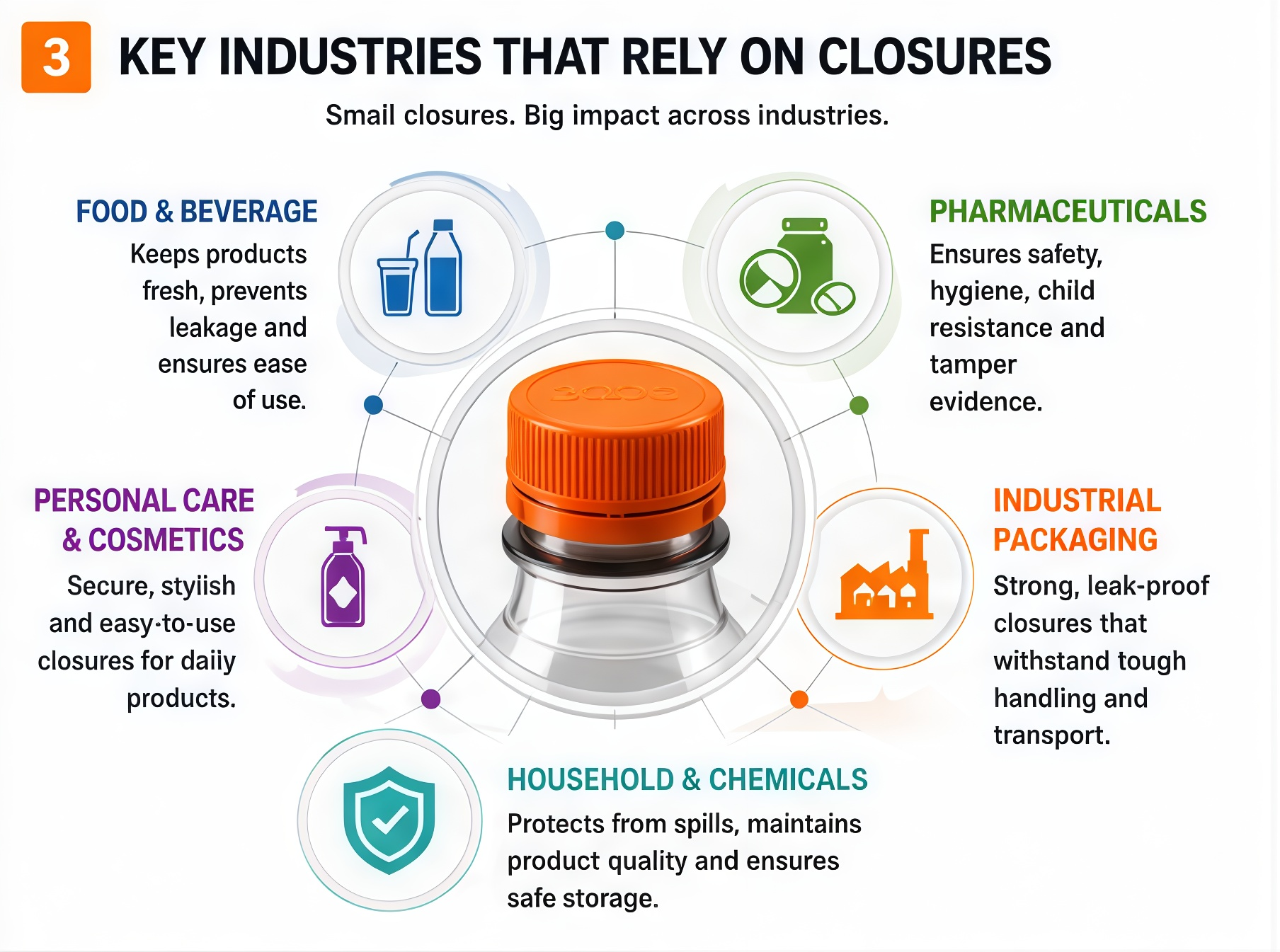
Food & Beverage
Keeps products fresh, prevents leakage and ensures ease of use. From water and juice to cooking oils and condiments, closures are the last line of defence between the product and the outside world.
Pharmaceuticals
Ensures safety, hygiene, child resistance and tamper evidence. Regulatory standards in pharma are among the strictest of any industry — closures must perform reliably every single time.
Personal Care & Cosmetics
Secure, stylish and easy-to-use closures for daily products. From shampoo to skincare, personal care closures must balance functional performance with shelf appeal.
Household & Chemicals
Protects from spills, maintains product quality and ensures safe storage. Chemical-resistant closures prevent container damage and protect users from hazardous contents.
Industrial Packaging
Strong, leak-proof closures that withstand tough handling and transport. Industrial closures must perform under extreme conditions — temperature variation, pressure, and rough logistics chains.
4. How Tamper-Evident Caps Work
A visible proof of safety and trust.
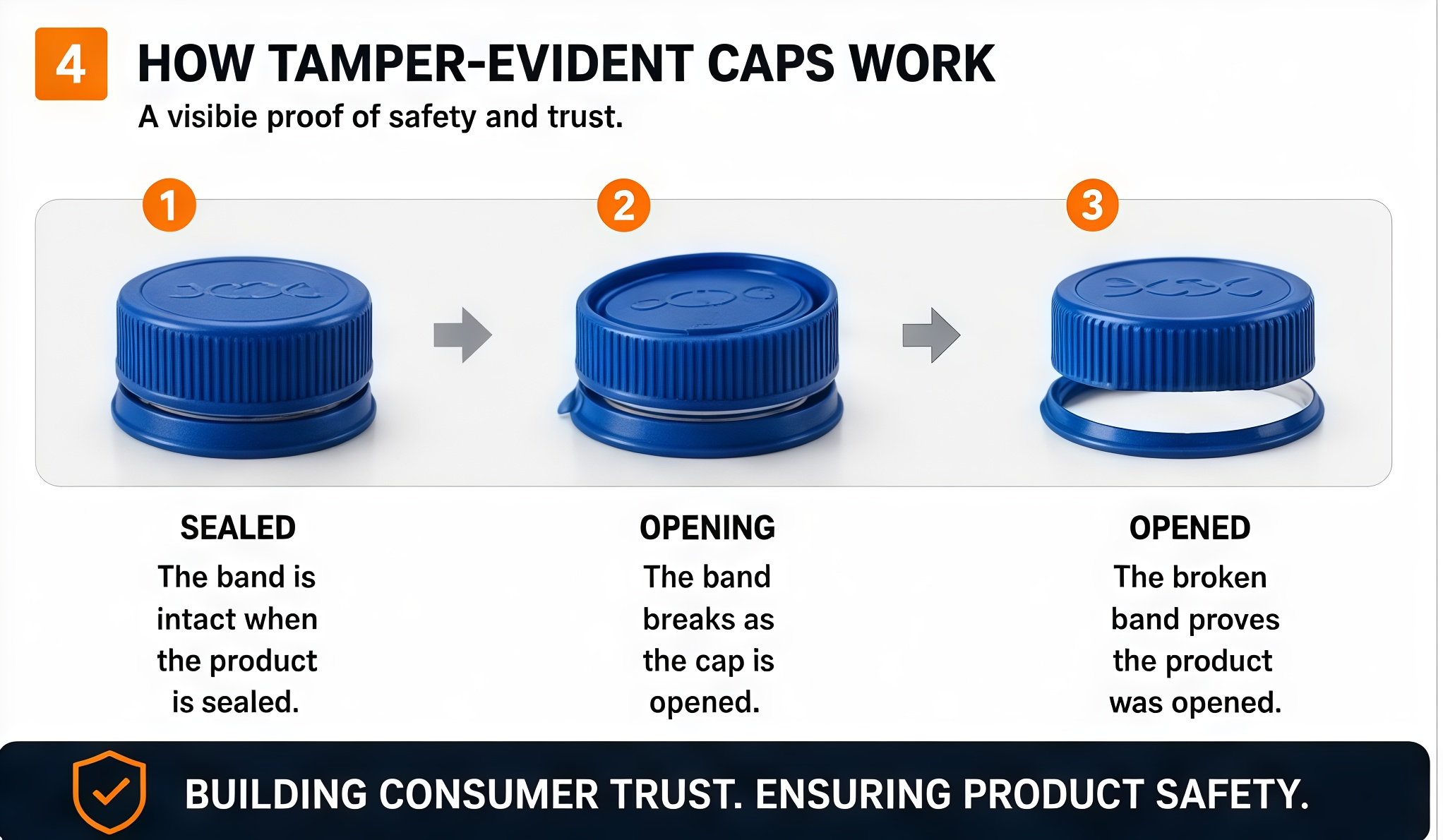
Tamper-evident closures work through a simple, three-stage mechanism that gives consumers immediate visual assurance of product integrity:
1 — Sealed: The band is intact when the product is sealed. This is the visual confirmation that the product has not been opened.
2 — Opening: The band breaks as the cap is opened. The break is irreversible and cannot be concealed or reattached.
3 — Opened: The broken band proves the product was opened. A consumer can see at a glance that the seal has been broken.
Building consumer trust. Ensuring product safety. Tamper-evident closures are mandatory for beverages, pharmaceuticals, and food products in most regulated markets worldwide. The tamper band is produced during the compression molding process and then precisely cut and folded by the Cap Slitting Machine and Cap Folding Machine to create the finished market-ready closure.
5. Child-Resistant Closures
Engineered for safety. Designed for peace of mind.
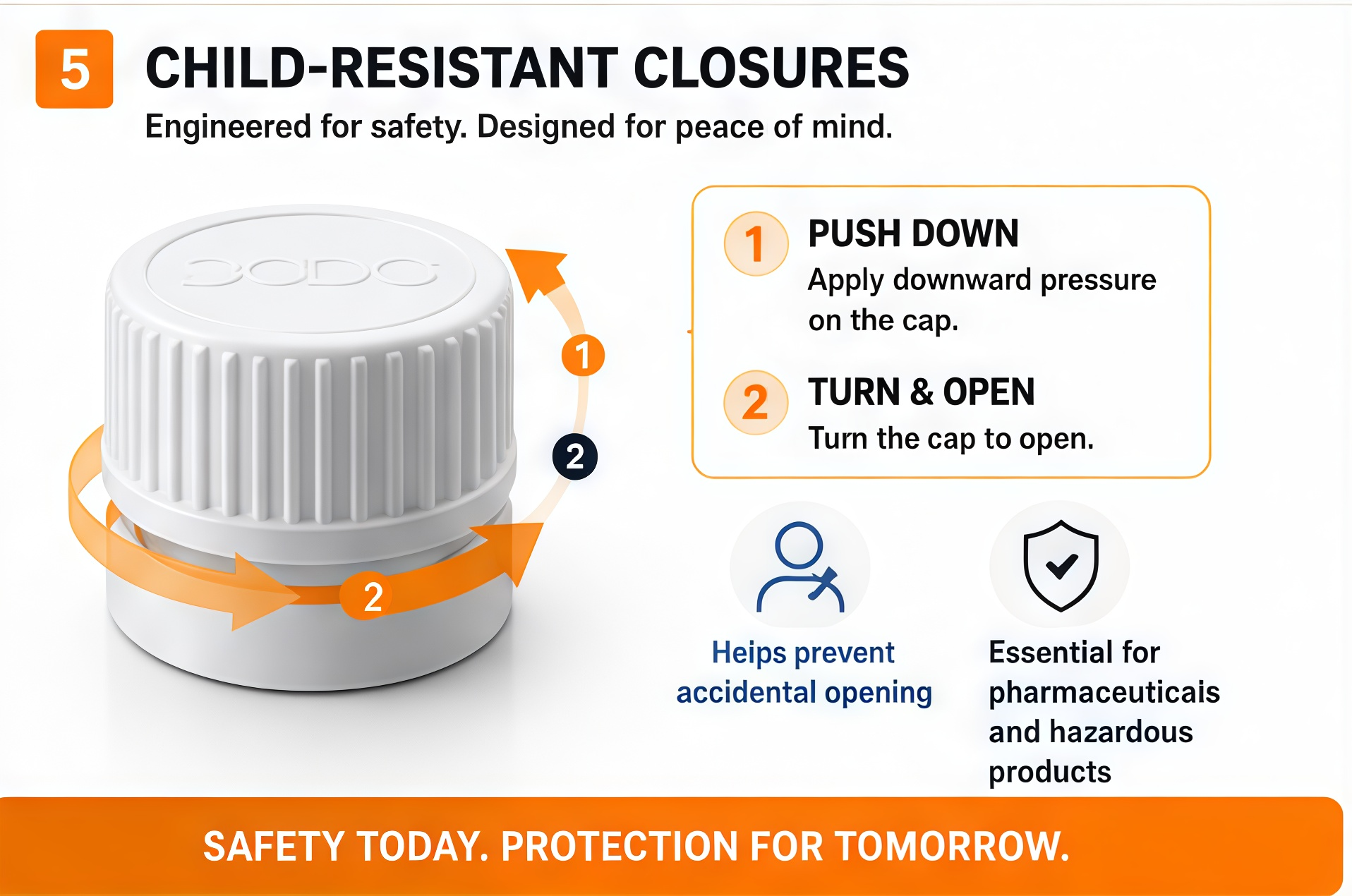
Child-resistant closures (CRCs) are a mandatory safety requirement for pharmaceutical and hazardous product packaging. Their design prevents accidental opening by children while remaining accessible to adults. The mechanism works in two steps:
1 — Push Down: Apply downward pressure on the cap. This disengages the locking mechanism before the cap will turn.
2 — Turn & Open: Turn the cap to open. Only when both actions are performed simultaneously will the closure release — a coordination that children typically cannot manage.
Helps prevent accidental opening and is essential for pharmaceuticals and hazardous products. Safety today. Protection for tomorrow.
6. What Does a Cap Actually Do?
More than just a lid — it protects what matters inside.
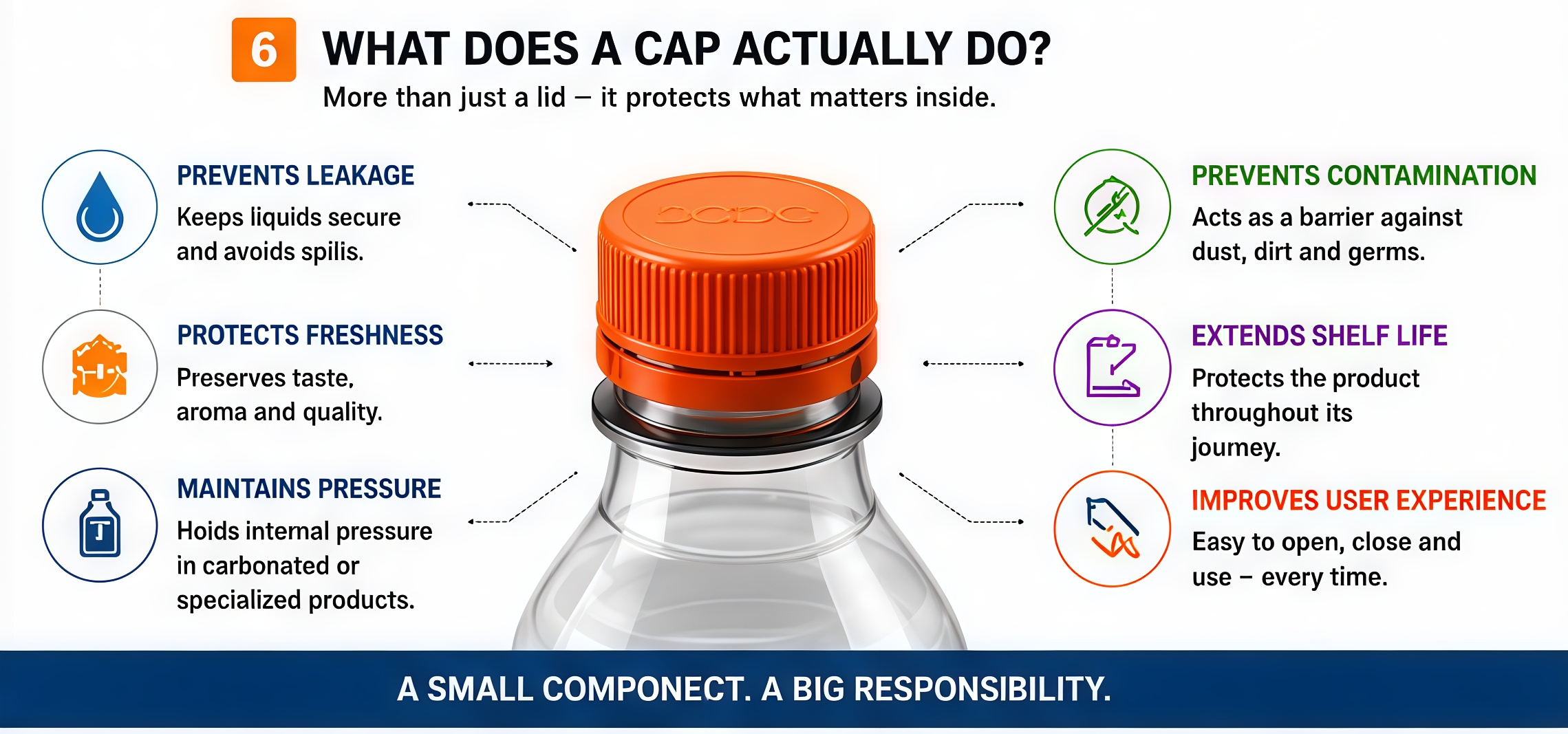
A cap or closure performs six core functions simultaneously across every product it seals:
Prevents Leakage: Keeps liquids secure and avoids spills throughout the supply chain and in the hands of the end user.
Protects Freshness: Preserves taste, aroma and quality by sealing out oxygen, moisture, and contaminants.
Maintains Pressure: Holds internal pressure in carbonated or specialized products — critical for CSD closures.
Prevents Contamination: Acts as a barrier against dust, dirt and germs — protecting product integrity from factory to consumer.
Extends Shelf Life: Protects the product throughout its journey — from manufacturing plant to retail shelf to the consumer's home.
Improves User Experience: Easy to open, close and use — every time. The right closure design turns a functional necessity into a brand asset.
A small component. A big responsibility. When a closure fails, the entire product fails with it.
Need a Cap Compression Molding Machine for Your Production Line?
Jobo India manufactures high-speed cap compression molding machines for water, CSD, juice, pharma, and cosmetic caps — with 35+ years of experience and machines running in 60+ countries.
Chat on WhatsApp8. Injection Molding vs Compression Molding
Better consistency. Better quality. Better results.
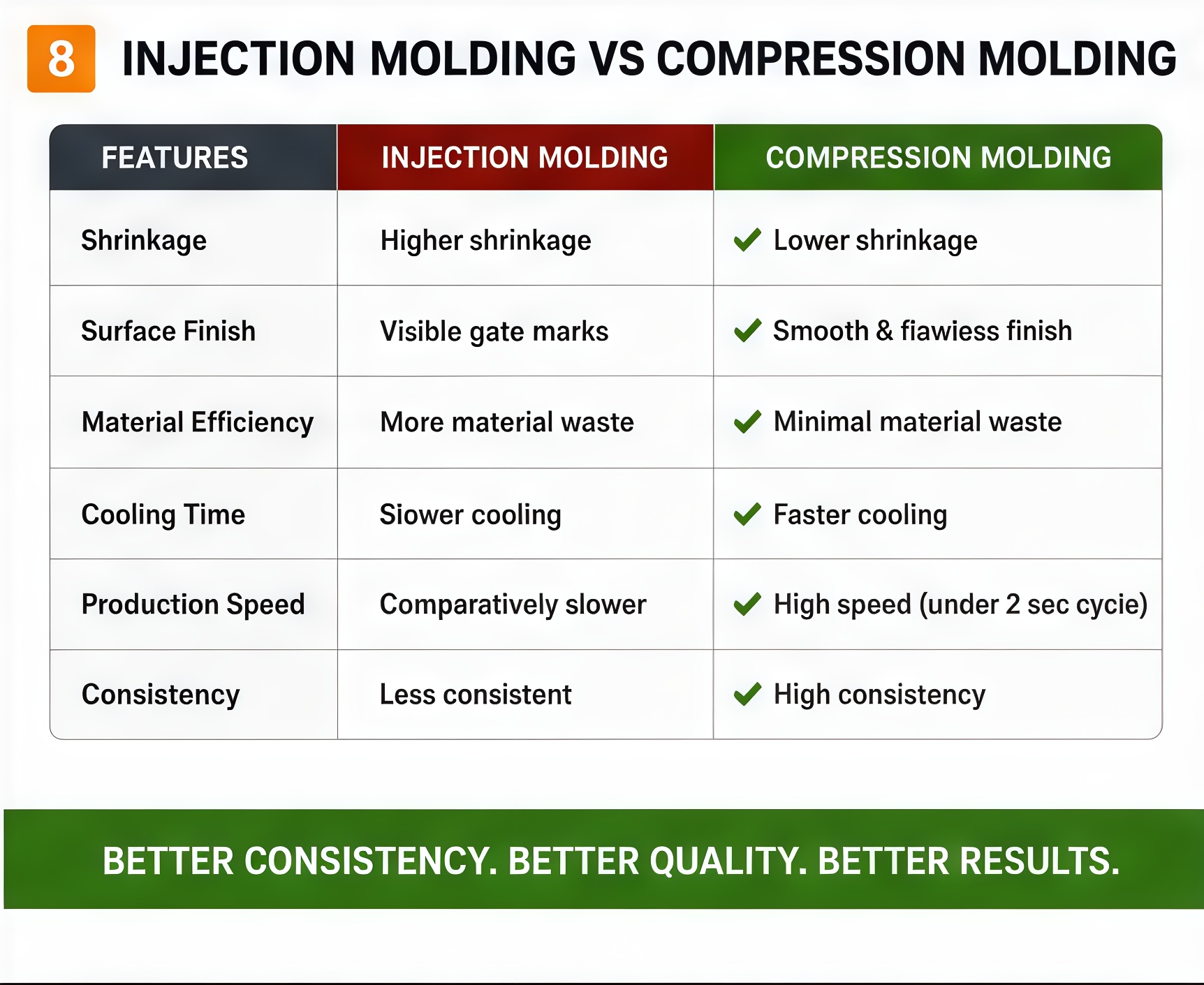
When it comes to producing plastic caps at scale, two manufacturing processes compete — injection molding (the older method) and compression molding (the modern standard). Here's how they compare across every key metric:
| Features | Injection Molding | Compression Molding |
|---|---|---|
| Shrinkage | Higher shrinkage | ✔ Lower shrinkage |
| Surface Finish | Visible gate marks | ✔ Smooth & flawless finish |
| Material Efficiency | More material waste | ✔ Minimal material waste |
| Cooling Time | Slower cooling | ✔ Faster cooling |
| Production Speed | Comparatively slower | ✔ High speed (under 2 sec cycle) |
| Consistency | Less consistent | ✔ High consistency |
Compression molding wins on every dimension. The process doses the exact amount of plastic needed for each cap, compresses it directly into the mold cavity, and ejects a finished cap with zero runners, zero sprues, and zero material waste. The result is a faster, more consistent, and more cost-efficient production line. Jobo India's Cap Compression Molding Machines — from the JOBO 16CS to the JOBO 36CSS — are built on this principle, producing up to 55,000 caps per hour with consistent quality across every cavity and every cycle.
9. The Global Closure Industry
A tiny component with a massive global presence.
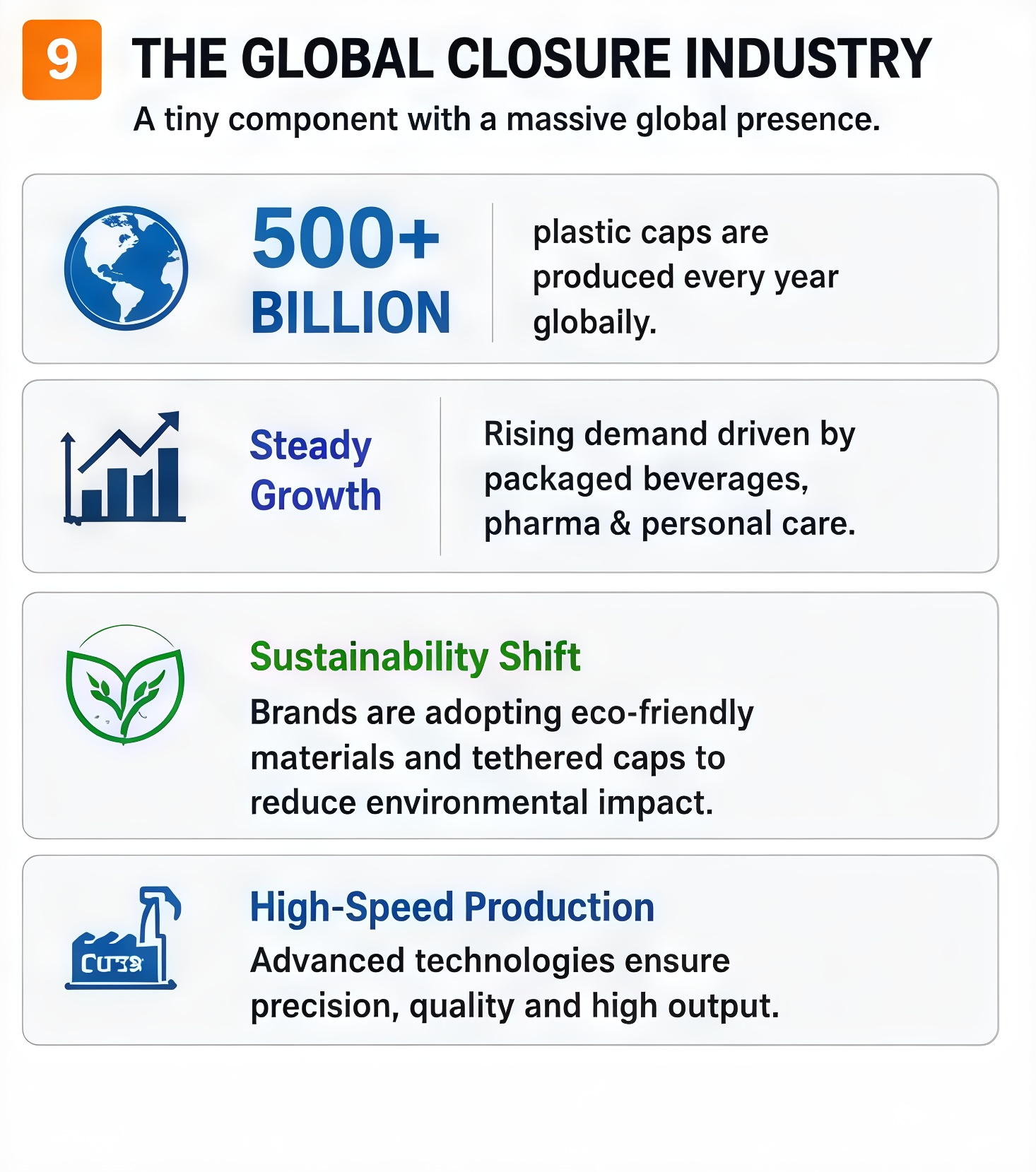
500+ Billion plastic caps are produced every year globally. Every beverage, medicine, personal care product, and food item you buy has a closure — the volume is staggering, and it continues to grow.
Steady Growth: Rising demand is driven by packaged beverages, pharma & personal care. As emerging markets grow, demand for packaged goods — and the closures that seal them — grows with it.
Sustainability Shift: Brands are adopting eco-friendly materials and tethered caps to reduce environmental impact. EU tethered cap regulations are accelerating this shift across global supply chains.
High-Speed Production: Advanced technologies ensure precision, quality and high output. Compression molding machines now produce tens of thousands of caps per hour with sub-second cycle times.
Get a Customized Machine Quotation
Share your cap size, daily production target, and application. Our team will help you select the right machine and provide a detailed quotation.
Call Now: +91 84694 59013Frequently Asked Questions (FAQs)
1. What are caps and closures?
Caps and closures are sealing devices placed on containers to prevent leakage, contamination, and tampering. They protect the contents of bottles, jars, tubes, and other containers across food & beverage, pharmaceutical, personal care, and industrial packaging industries.
2. What are the main types of caps and closures?
The six main types are screw caps, flip-top caps, snap-on caps, dispensing closures, child-resistant closures, and tamper-evident closures. Each is engineered for specific applications and industries.
3. What materials are used to make caps and closures?
The most common materials are HDPE (high-density polyethylene) for beverage caps, PP (polypropylene) for pharmaceutical and personal care closures, metal (aluminium and tinplate) for premium packaging, and sustainable materials including bioplastics and recycled plastics.
4. How does a tamper-evident closure work?
A tamper-evident closure has a security band that remains intact when sealed. When the cap is first opened, the band breaks permanently — giving visible proof that the product has been opened. This cannot be concealed or reversed.
5. What is a child-resistant closure and how does it work?
A child-resistant closure requires a two-step action — push down and turn simultaneously — to open. Children typically cannot coordinate both actions at once, making the closure resistant to accidental opening. CRCs are mandatory for pharmaceuticals and hazardous product packaging in most regulated markets.
6. Why is compression molding better than injection molding for caps?
Compression molding produces caps with lower shrinkage, a smooth and flawless surface finish, zero material waste (no runners or sprues), faster cooling times, higher production speeds under 2 seconds per cycle, and greater consistency — outperforming injection molding on every key metric.
7. How many plastic caps are produced globally each year?
Over 500 billion plastic caps and closures are produced annually worldwide. Demand continues to grow, driven by packaged beverages, pharmaceuticals, and personal care products — particularly in emerging markets.